
AI Voice vs Human Voice (Honest Comparison – Real Use, Pros, Cons & Future)
AI voice technology has transformed how audio content is created. What once required professional recording equipment, voice actors, and hours of editing can now be done in minutes using advanced text-to-speech systems.
But this rapid growth raises a key question:
Is AI voice actually better than human voice or just more convenient?
The honest answer is that both have strengths and limitations. In this in-depth guide, we’ll break down the real differences based on practical use, not hype or promotion.
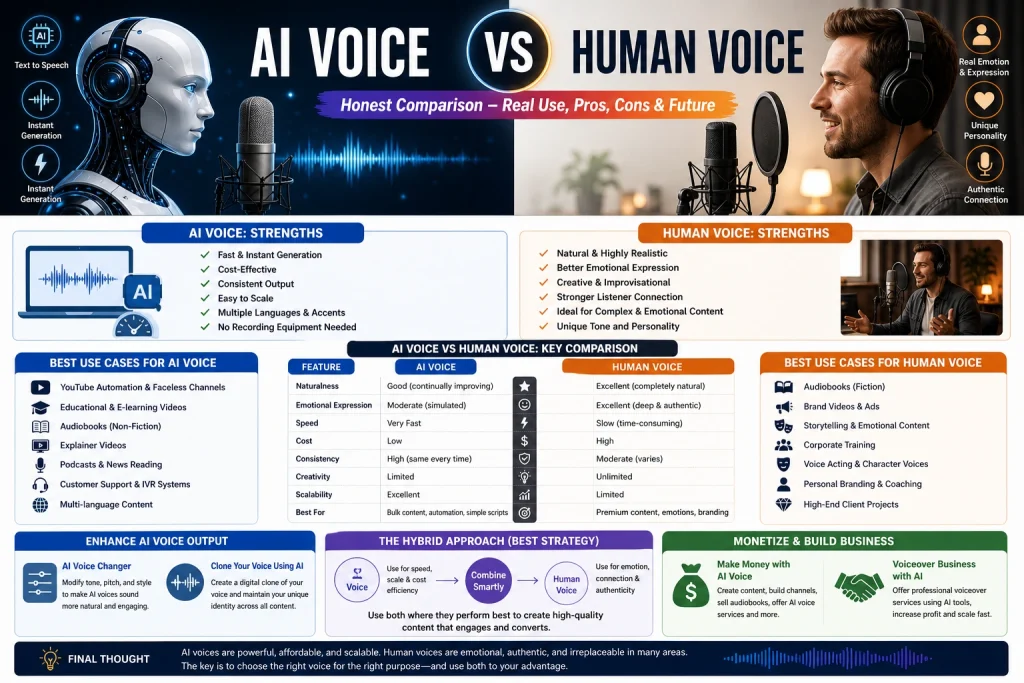
What Is an AI Voice?
An AI voice is generated using text-to-speech (TTS) technology powered by machine learning. These systems are trained on human speech patterns to produce realistic audio output.
Modern AI voices can:
- Sound highly natural
- Adjust tone, speed, and pitch
- Generate long-form narration
- Replicate or clone voices
AI voices are widely used in:
- YouTube content
- Audiobooks
- Online courses
- Business automation
If you’re new to this space, understanding how AI Voices for Storytelling work can help you see how far the technology has come in real-world applications.
What Is a Human Voice?
A human voice refers to real recordings made by voiceover artists or content creators.
Human narration offers:
- Natural emotional depth
- Unique personality
- Real-time expression
- Authentic delivery
This is why human voices are still widely used in:
- Films
- Premium audiobooks
- Advertising
AI Voice vs Human Voice: Core Differences
1. Naturalness and Realism
AI Voice:
Modern AI voices sound impressive, especially in short content. However, in longer narration, subtle unnatural patterns can still appear.
Human Voice:
Naturally fluid, with organic variations in tone and delivery.
Verdict:
Human voice still leads in realism, especially for storytelling.
2. Emotional Expression
AI Voice:
Can simulate emotion, but often lacks depth or sounds slightly artificial.
Human Voice:
Naturally conveys:
- Emotion
- Intention
- Subtle meaning
Verdict:
Human voice is far superior for emotional storytelling.
3. Speed of Production
AI Voice:
- Instant generation
- Easy edits
- No recording setup
Human Voice:
- Requires recording time
- Editing and retakes
Verdict:
AI wins in speed.
4. Cost Efficiency
AI Voice:
- Low cost
- Subscription-based
- Unlimited usage
Human Voice:
- Expensive per project
- Ongoing costs
Verdict:
AI is more cost-effective.
5. Consistency
AI Voice:
- Same output every time
- No fatigue or variation
Human Voice:
- Slight variation between recordings
Verdict:
AI is more consistent.
6. Creativity and Improvisation
AI Voice:
- Follows script exactly
- No improvisation
Human Voice:
- Adds personality
- Adjusts delivery naturally
Verdict:
Human voice dominates creativity.
7. Scalability
AI Voice:
- Create large volumes of content quickly
Human Voice:
- Limited by time
Verdict:
AI is better for scaling.
Real Use Case Comparison
1. YouTube Content Creation
AI voices are widely used for:
- Automation channels
- Educational content
- Storytelling videos
If you are building content similar to AI Voice for YouTube Videos, AI voices can significantly speed up production.
However, human voices are better for:
- Personal branding
- Face-based content
- High engagement videos
2. Audiobooks
AI Voice:
- Suitable for non-fiction
- Works for simple narration
Human Voice:
- Better for fiction
- Strong emotional delivery
3. Business Content
AI Voice:
- Explainer videos
- Training content
- Automation
Human Voice:
- High-end ads
- Brand storytelling
4. Voice Customization and Effects
AI tools now allow advanced customization, including tone and effects.
However, over-relying on tools like an AI Voice Changer without focusing on script quality can reduce overall content quality. The voice is only as good as the content behind it.
