
Best AI Voices for Storytelling (Real Tests, Deep Analysis & Practical Guide)

AI voice technology has evolved rapidly in recent years. What once sounded robotic and flat can now produce highly natural narration that works for real-world storytelling. Today, creators are using AI voices for YouTube, audiobooks, podcasts, and even full storytelling businesses.

But here’s the reality not all AI voices are good for storytelling.

Some sound unnatural in longer content. Others lack emotion. And many fail to keep listeners engaged beyond a few minutes.

This guide is based on real testing and practical usage, not affiliate promotion. It will help you understand which AI voices work best, why they work, and how to use them effectively for storytelling.
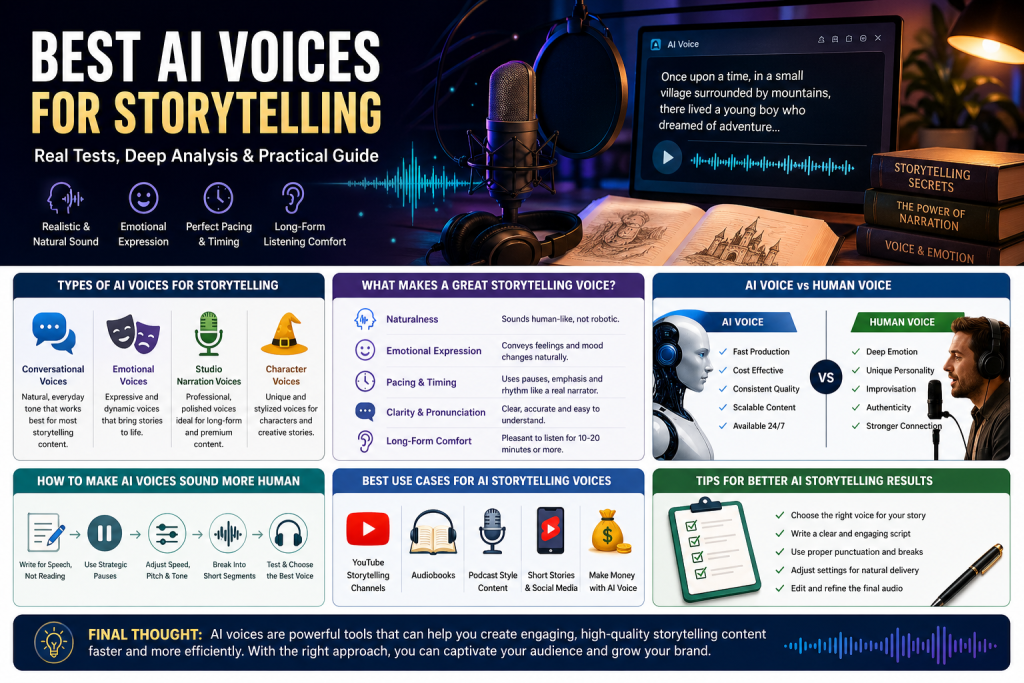
What Makes an AI Voice Good for Storytelling?

Storytelling requires more than just reading text aloud. A good storytelling voice must create emotion, rhythm, and engagement.

Key factors we evaluated:

1. Naturalness

A storytelling voice must sound human-like. Robotic voices break immersion instantly, especially in longer narratives.

2. Emotional Expression

Stories involve mood changes suspense, excitement, sadness. A good AI voice should reflect these shifts naturally.

3. Pacing and Timing

Good narration includes:

  • Pauses
  • Emphasis
  • Rhythm

Without this, storytelling feels flat.

4. Clarity and Pronunciation

Mispronunciations or awkward phrasing can ruin listener experience.

5. Long-Form Listening Comfort

Some voices sound fine for 30 seconds but become tiring over 10–20 minutes.

How We Tested AI Voices

We tested multiple voice types using:

Script Types:

  • Emotional storytelling
  • Suspense narrative
  • Conversational tone

Testing Method:

  • Default output
  • Optimized settings (speed, tone)
  • Real listening tests with headphones

Types of AI Voices That Work Best for Storytelling

Instead of promoting tools, we focused on voice performance categories.

1. Conversational AI Voices (Best for Most Use Cases)

These voices mimic everyday human speech.

Why they work:

  • Natural tone
  • Easy listening
  • Good pacing

Ideal for:

  • YouTube storytelling
  • Educational content
  • General narration

If your focus is creating content like AI Voice for YouTube, conversational voices are often the most reliable starting point.

2. Emotional AI Voices (Best for Engagement)

These voices simulate emotional variation.

Why they work:

  • More expressive delivery
  • Better audience retention
  • Strong storytelling impact

Ideal for:

  • Horror stories
  • Drama
  • Audiobooks

3. Studio Narration Voices (Best for Professional Output)

These voices sound polished and consistent.

Why they work:

  • High clarity
  • Professional tone
  • Clean audio quality

Ideal for:

  • Monetized content
  • Long-form storytelling
  • Audiobooks

4. Character Voices (Creative Use Only)

These voices are stylized and unique.

Why they work:

  • Distinct personality
  • Creative storytelling

Limitations:

  • Not suitable for long content
  • Can become tiring quickly

AI Voice vs Human Voice for Storytelling

Where AI Voices Excel

  • Fast production
  • Low cost
  • Scalability
  • Consistency

Where Human Voices Still Win

  • Deep emotional expression
  • Authentic storytelling
  • Improvisation

Final Take

AI voices are ideal for:

  • YouTube automation
  • Educational storytelling
  • Scalable content production

But for highly emotional storytelling, human narration still has an edge.

Common Mistakes That Ruin AI Storytelling

Even the best AI voice can fail if used incorrectly.

1. Using Default Output Only

Always adjust:

  • Speed
  • Tone
  • Pauses

2. Writing Like a Blog

Storytelling scripts should be conversational, not formal.

3. Ignoring Structure

Break your content into smaller sections for better flow.

4. Choosing the Wrong Voice

Different voices suit different storytelling styles.

5. Overusing Effects Without Understanding Basics

Some creators rely too much on tools like an AI Voice Changer without focusing on script quality. Effects can enhance storytelling, but they cannot fix poor narration structure.

How to Make AI Voices Sound More Human

This is where you gain a real advantage.

1. Write for Speech, Not Reading

Use:

  • Short sentences
  • Natural flow
  • Simple words

2. Use Punctuation Strategically

Commas and pauses help create natural rhythm.

3. Adjust Delivery Settings

Small tweaks in:

  • Speed
  • Pitch

Can dramatically improve output.

4. Segment Your Audio

Generate shorter sections instead of long continuous scripts.

5. Experiment with Voice Types

Test multiple voices before finalizing.

Advanced Use: Voice Cloning in Storytelling

Voice cloning is becoming increasingly popular.

With tools that allow you to Clone Your Voice Using AI, creators can:

  • Maintain a consistent brand voice
  • Personalize storytelling
  • Build unique audio identity

However, voice cloning requires:

  • Careful tuning
  • Ethical use
  • High-quality input samples

Best Use Cases for AI Storytelling Voices

1. YouTube Storytelling Channels

AI voices are widely used for:

  • Crime stories
  • Motivation
  • Educational content

If you’re focusing on video content, understanding AI Voice for YouTube strategies can significantly improve engagement and retention.

2. Audiobooks

AI voices are effective for:

  • Non-fiction
  • Simple storytelling formats

3. Podcast-Style Content

AI narration works well for:

  • Informational storytelling
  • Commentary

4. Content-Based Income Streams

Many creators are now exploring ways to Make Money with AI Voice by:

  • Creating YouTube channels
  • Selling audiobooks
  • Offering narration services

Building a Business with AI Storytelling

AI voices are not just tools they can support full business models.

If you’re planning to scale, consider building a Voiceover Business with AI, where you:

  • Offer narration services
  • Create bulk content
  • Work with clients globally

Evaluating AI Voice Tools (Without Bias)

When testing any tool, focus on:

  • Voice realism
  • Emotional range
  • Output quality
  • Customization options

If you’re analyzing specific tools, reading a detailed Playht AI Review or similar breakdowns can help you understand real-world performance before choosing a platform.

Future of AI Storytelling Voices

AI voice technology is improving rapidly.

We are seeing:

  • More realistic speech models
  • Better emotional control
  • Real-time voice generation

What This Means for Creators

  • Faster content production
  • Lower costs
  • More competition

The creators who succeed will focus on:

  • Quality
  • Storytelling skill
  • User experience

Final Verdict

AI voices are now powerful enough to create engaging storytelling content at scale.

They offer:

  • Speed
  • Efficiency
  • Consistency

But success depends on:

  • Script quality
  • Voice selection
  • Proper optimization

FAQ

What is the best AI voice for storytelling?

Conversational and emotional AI voices perform best for most storytelling needs.


Can AI voices replace human narrators?

Not completely, but they are highly effective for most content types.


How can I improve AI voice quality?

Focus on:

  • Better scripts
  • Proper formatting
  • Voice tuning

Is AI storytelling content allowed for monetization?

Yes, as long as it provides value and is not spammy.


Conclusion

AI storytelling voices have transformed content creation. They are no longer just experimental tools, they are practical solutions for creators who want to produce high-quality content efficiently.

Whether you’re creating YouTube videos, audiobooks, or building a scalable content business, AI voices can play a major role in your workflow.

The real difference comes from how you use them. With the right approach, structure, and attention to detail, you can create storytelling content that truly engages your audience.

Ricly L is a dedicated content creator and digital strategist behind the PlayHT AI platform, specializing in text-to-speech technology and AI-driven voice solutions. With a strong focus on creating high-quality, user-focused content, Ricly helps individuals and businesses discover the power of realistic AI voices for content creation, marketing, and automation. Passionate about innovation, Ricly continuously explores the latest advancements in AI voice generation to deliver insightful guides, reviews, and resources that simplify complex technologies.

Leave a Reply

Your email address will not be published. Required fields are marked *